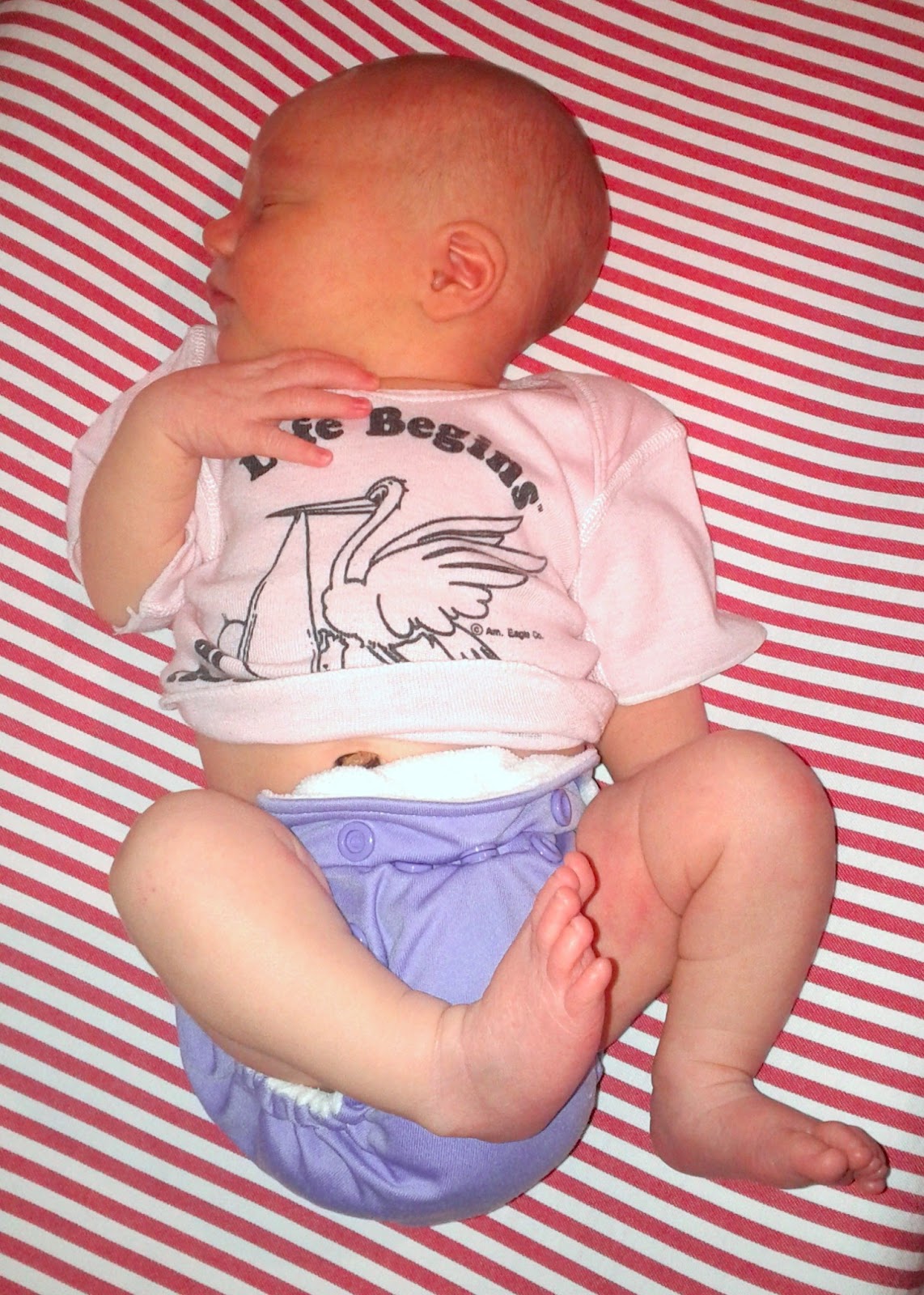
Showing posts with label Cloth Diapers. Show all posts

12 December 2014

Friday I'm in Love

Happy Friday. I know that I'm late to the game, but better late than never, right? Right. 

ONE: Glassybaby
I've wanted a Glassybaby for as long as I've known about them (just about as long as I've lived in Washington), and I got my first two earlier this year. I just added a couple more to my collection to help with holiday decorating (stay tuned). Not only are Glassybabies gorgeous and unique, but the company gives 10% of every sale to charity as part of its humble and inspiring beginnings

TWO: Bum Genius Elemental Diapers
Bum Genius Elementals are currently my favorite cloth diaper. They're an all-in-one, one-size diaper with super absorbent liner. I had two of them with Madeleine which have become my favorites for Elliott, so my best Black Friday deal was to stock up with a few more. They just arrived, and I can't wait to add them to my stash and get them on Elliott's lil' bum!

THREE: This List of Kids Books
Books are one of my favorite gifts to give to kids and receive for my own kids. Madeleine and Elliott have a million and will probably never have too many. I was thrilled for this list of hot kids books from 2014 to pop up on my reader this week - just in time for some last minute shopping! 

It's not too late - check out what MishaKendraMary Beth, and Laura are loving this week, too. 

16 May 2014

Friday I'm in Love

I'm back with another edition of Friday I'm in Love, highlighting a few things that have recently caught my eye and made my heart go pitter patter. Be sure to check out Misha's and Kendra's picks for the week, too!

ONE: Super easy watermelon cutting method

I love watermelon yet always hesitate to buy them because of dreading the cutting process. For Misha's shower, I used this super easy method for the second time. It works like a charm, leaving you with uniform cubes of watermelon in no time at all!

TWO: Blooming Azaleas and Rhododendrons 

Azaleas and rhodies do very well in the Pacific Northwest, but we only get to enjoy their full blooming beauty for a couple of weeks each year. I've been tempted several times in this past year to pull out the large quantities of azaleas we have planted in our yard, but I now withdraw my protests after seeing the show our garden is putting on this spring. Wow!


THREE: Bamboo clothing

I just can't get enough bamboo clothing lately. The few pieces of Kickee Pants wear that Madeleine had as a baby were favorites, winning a spot in my heart for being soft, stretchy (ie having an extended fit time), and environmentally friendly. I recently learned that they're local (based on Bainbridge Island), and I've been shopping for another piece or two for our newest little one. It remains to be seen whether I can resist the strong urge to pick up on of their adult gowns for myself.

FOUR: Sun + Cloth Diapers

As the frequency of sunny days increases, I find myself excited about hauling my drying rack and freshly laundered cloth diapers outside to spend the day in the sun. It's amazing what a few hours in the sun can do to stains and funky smells, even if our spring Seattle sun isn't quite warm enough to dry the diapers all the way through.


Having enjoyed a sunny week in Seattle, there's a lot to love. What are you loving this Friday? 

29 March 2013

Cloth Diapering: Traveling with Cloth Diapers

Let's wrap up this cloth diapering series by talking about what it's like to use cloth diapers while traveling. In case you missed the previous posts in the series, be sure to also check out the basics, how to get started and care for your diapers, the Gilbertson family's experience, and our family's experience.

Just because you cloth diaper at home doesn't mean that cloth diapering is always the best option while you're away from home. I'm not talking about going to play group, the store, or even spending a night at Aunt Suzie's house; I'm talking about being away from home...like on an airplane and in another time zone away.

First, let me share how we decide whether we're going the cloth or disposable route on the road.

Will there be access to laundry?
    No --> Use disposable. We have a policy of not flying with dirty diapers because you never know when luggage may be delayed or smelly diapers may interest security screening dogs. Just, no.
    Yes --> Keep considering cloth.

How accessible is the laundry? If the laundry belongs to a friend/family member, are they okay with you laundering diapers in their machines?
    Coin laundry --> Use disposable. We don't want to risk damage to our diapers or the hassle of guessing how many drying cycles it'll take to fully dry the diapers.
    Laundry where we're staying --> Talk to the host about doing diaper laundry. If they're okay with it, keep considering cloth.

How long will we be gone?
    Less than 4 days --> It's probably not worth taking cloth diapers when one pack of disposables will cover the whole time and we'd barely have enough time to use and wash the diapers before packing up to go home again.
    More than 4 days --> Keep considering cloth.

At this point, we usually consider other factors, including the amount of space and weight we have in our luggage, the amount of times we'll be able to use the diapers while we're gone, and whether we'll have time to do diaper laundry while we're traveling.

So far, the only time we've decided to do cloth diapers during a trip away from home was when we spent more than a month in New Zealand. We stayed almost entirely with family (who were graciously supportive...or at least tolerant...of our cloth diapering) and knew that we'd be able to use the diapers over and over again while saving trips to the store for diapers and space in a landfill.

Next, let's talk about the pros, cons, and experience of cloth diapering while away from home.

Pros:

  • Using the same diapers as normal means consistency for the little one and you. You can largely avoid figuring out which brand of disposable will result in the fewest leaks/rashes, which is especially nice when traveling internationally. 
  • If you're traveling somewhere sunny, it's a good opportunity to get the diapers in the sun for some serious natural disinfectant. 
  • If you're going to access laundry for diapers every few days, you can pack fewer clothes and do some clothing laundry at the same place you're laundering diapers. 

Cons:

  • Diapers can get heavy and are certainly bulky, so they have the potential to take up a lot of luggage space and weight. 
  • You have to do laundry on vacation. Wah-wah. Then again, if you're a parent and you're traveling for any length of time, you'll be doing laundry anyway. Wah-wah.

As I mentioned, we took our cloth diapers to New Zealand and had a great experience. We used the itti bitti d'lish snap in ones. Because we can reuse the outer cover and only go through two or three per day, we took about half as many outer covers as we did inserts. I took two large wet bags so that one wet bag could be in the wash while we filled the other with another round of dirty diapers. We also used the extra wet bags to carry clean diapers while traveling between places.

As for laundry, I took a baggie of our Charlie's Soap, which we used most of the time (until I forgot it and my mother-in-law had to ship it across the country to us - thanks, Pat!). We didn't have problems with border security being nervous about our white powder, but I figured they'd be able to test it if we did have problems. I enjoyed being able to use different washing machines as we were shopping for a new machine at home, and using different features helped me narrow down what I liked and didn't like. I also loved (loved, loved, loved) being able to hang our diapers in the sunny New Zealand air. One afternoon on the line eliminated nearly six months of diaper stains. Awesome! And...I learned the hard way that we could have packed fewer clothes because we were washing diapers so frequently.

Overall, I'd definitely do it again, and I look forward to our next trip that is long enough to make it worth packing our nappies!

What about you - if you cloth diaper at home, have you done it while traveling? How did it go? Would you consider it in the future?


The rest of the cloth diapering series:
   The Basics
   Getting Started & Daily Care
   Kendra, Greg, & Kenley's Experience
   Our Experience & Product Reviews

06 February 2013

Sale!

Curious about the itti bitti d'lish diapers that we love? They're currently discontinuing last year's colors before releasing a whole new batch of fun colors next month. This means you can find them on sale various places including Kelly's Closet, which is currently running both the snap in ones and all in ones at 30-percent off! Hurry - they're already out of stock on a few combinations.

Enjoy your fluffy bums!

04 February 2013

Cloth Diapering: Our Experience & Product Reviews

Cloth diapering is a confusing world, so I'm sharing what I've learned over the last six months in hopes of helping others who are considering cloth diapering. Be sure to check out the basics, what you need to know to get started and maintain cloth diapers, the Gilbertson Family's experience, and traveling with cloth diapers. Today, I'm sharing our experience with cloth diapers and my review of a few products we've used...and learning that I don't have many photos of Madeleine's fluffy bum since the weather turned cold.

Our Experience
Sometime in my pregnancy with Madeleine, George and I became curious about cloth diapers. We were both raised on cloth diapers and had seen many of our friends use them but really didn't know where to begin ourselves. So, we attended an introductory class about cloth diapers; we walked away totally baffled by the options and wondering if the class leader was right when she said it was really as simple as a few extra loads of laundry a week (she was!). Eventually, we decided that we would buy cloth diapers for the first size and allow ourselves to back out at the end of the first size or if it got too hard.


I don't remember the exact thought process, but we ended up investing in several Thirsties Duo covers and a dozen prefolds. When I saw different diapers come across BabySteals or in good shape at a secondhand shop, I'd buy one to give it a try. I was also given two Lil Joey newborn diapers by a friend of a friend. So, when Madeleine was born, we had a stash of mostly prefolds and covers with a few random diapers.

For the first couple days of Madeleine's life, we used newborn disposable diapers. This made it easy to dispose of the nasty tar poo but made us realize this: disposable diapers are expensive, pile up quickly, and are a hassle to constantly buy. As soon as the meconium was gone, we added the Lil Joey diapers into the rotation (because they fold down in the front, they protected the umbilical stump just like disposable newborn diapers). Guess what - we (especially George) loved them!

First Cloth Diaper: 3 Days Old

Credit

But...Madeleine was less than 8 pounds (the starting size for most cloth diapers) for the first several weeks of her life. Even after she was 8 pounds, the prefolds and covers were ridiculously big on her. They may have functioned fine, but she looked so uncomfortable with diaper all the way to her knees! So, we stayed with disposable diapers (and Lil Joeys as long as they fit) for a few more weeks.

Then, when Madeleine was six or seven weeks old, we visited a friend in Ohio whose daughter is a week younger than Madeleine and very similar in build. She told me how much she liked the Thirsties Duo All in One, and I saw that it fit Miss A nicely, even at her petite size. We came home, ordered a few Thirsties Duo All in Ones, and started cloth diapering full time. Remember our weekly photo to commemorate it?

As Madeleine got a bit older and a bit bigger, we added the covers and prefolds into the rotation as well as the random diapers I'd found on sale or secondhand. Using the covers and prefolds was always a bit of a chore because the all in ones were easier and provided a better fit. And through the collection of random diapers, I found our favorites: itti bitti d'lish. More on them below. I've recently taken the prefolds and covers out of the nursery because we weren't using them at all. And, because the itti bitti d'lishes and Thirsties are all sized, we're just a few pounds away from needing to replace most of our stash. I'm excited for more of our favorites and a few new brands. Any recommendations?

November

Are there times when we don't use cloth diapers? Yes. We put Madeleine in a disposable (our favorites) after her bath each night. If she gets a bad diaper rash, we pull out the Triple Paste (not safe for cloth diapers) and go to disposables for a day or three. When we travel and do not have access to washing facilities, we use disposables. We also keep a few disposables in the diaper bag for emergencies. Otherwise, I find using cloth diapers at home (with the system I described) and on the go (using a wetbag and otherwise adding them to the at-home system when we get home) is pretty easy.

A Few Product Reviews
Plant Wise Pail Liner: I use these in the pail and to carry the diapers to the laundry Santa style. These have held up to my use and a million washes and dries. My only problem was that the red one bled the first time that I washed it. Boo for pink diapers.

Thirsties Duo Wrap Cover: These are great as covers go. They have gussets around the leg, which are great for wee legs. The snap and hook and loop closures both held up to the little use we gave them.

Lil Joey by Rumparooz: These are a great introduction to cloth diapering. They're perfect for newborns because they can be snapped down in the front to protect the umbilical cord stump and are well designed to fit small frames. Unfortunately, they take a while to dry, too.

Thirsties Duo All In One: These are really easy all in ones to use. Their absorbancy is borderline for a heavy wetter. I wonder if the sizing snaps on the front are useful for anyone else because they were not for us. They are somewhat trim fitting and typically take two rounds of drying.

Charlie Banana One Size Pocket Diaper: This is one of the randoms that I acquired on sale. I love how stretchy it is, and I can imagine that it will fit Madeleine for a long time. We're at the point where it needs an extra booster to be absorbant. George doesn't like the pocket part of it because he can't get the insert stuffed into the narrow opening, but I think we can make it work as long as my smaller hands do the stuffing.

itti bitti d'lish all in one: I love the plush exterior of the diaper and the ease of its all in one form. It is extremely trim fitting (though not quite as much as the snap in one version). Because it's so absorbant, its drying time it toward the longer end.

itti bitti d'lish snap in one: This is our favorite diaper. The outer is plush and waterproof. The absorbancy can be customized by the layering of inserts. Even though it's sized, the inserts can be used in the larger sized diapers. Outers can be reused unless they're soiled or soaked, which limits the wear and tear on the outers (ours are still as nice as the day they arrived). Because they're in separate pieces, they dry quickly.

A Pep Talk
There are many ways to go about cloth diapering, and it doesn't have to be a complicated process. If you're curious about cloth diapering, I encourage you to buy a couple diapers and give it a try. Maybe you'll hate it and find yourself content in using disposables. Or, maybe you'll find that you love cloth diapering.

Come back soon to hear about how we use cloth diapers while traveling. In the mean time, feel free to leave questions, comments, or recommendations for new brands to try. Oh, and it must be cloth diapering season in our corner of the world because Emily at Daily Garnish just gave an update on her cloth diaparing experience. Check it out for yet another perspective.

The rest of the cloth diapering series:
   The Basics
   Getting Started & Daily Care
   Kendra, Greg, & Kenley's Experience
   Traveling with Cloth Diapers

01 February 2013

Cloth Diapering: Kendra, Greg, & Kenley's Experience

Welcome to the third post in this series discussing cloth diapers! Cloth diapering is a confusing world, so I'm sharing what I've learned over the last six months in hopes of helping others who are considering cloth diapering. Be sure to check out the basics, what you need to know to get started and maintain cloth diapers, our experience with cloth diapers, and traveling with cloth diapers.

For today's post, I asked Kendra, who blogs at The Gilbertson Family, to stop by and share her cloth diapering experience and wisdom. Welcome!


Hello! I'm Kendra...wife to Greg, and mama to Kenley. We are The Gilbertson Family. I am so excited to be a guest here today with Amanda to share our experiences with cloth diapers. I remember being pregnant and reading and reading about other moms' experiences, likes, and dislikes. Quite frankly, I love cloth diapering, so I will talk about it to anyone who will listen!

The main reason we decided to go the cloth diaper route was because the idea of throwing our money away (literally) by using disposable diapers really did not sound appealing to us. When I presented the idea [of using cloth diapers] to Greg, he was skeptical but willing to listen. Once he looked at the numbers, he was sold. Of course, we knew at the time there were so many other benefits and we have come to learn even more since we started using them, but we love not having to buy disposable diapers each month.

We made this decision fairly early in our pregnancy, which allowed us to keep our eyes peeled for good deals and put some of the cloth diaper essentials on our registry (score). One argument against cloth diapers is the upfront cost, so starting early helped. Fear not though, I am fully convinced that you can start cloth diapering at any point, even if your baby or babies are already here. It's never too late, in my opinion. So what are these "essentials" I speak of? Well, to begin...the diapers. Our stash consists of mainly BumGenius 4.0 pocket diapers, 23 to be exact. We also have 1 Blueberry, 2 GroVia All In One, 1 Bumkins All In One, and 1 BumCheeks Minky. All of our diapers are one size diapers, meaning they will grow with the baby, so you can use the same diapers throughout the diapering process and then use them again for future babies.


I tend to like the pocket diapers best for a couple reasons. First, you can create the perfect diaper depending on the number of inserts you want to use. We typically use a regular insert, a doubler (a thinner insert), and the cover to make one diaper. At night, we use the bamboo inserts with the Blueberry diaper cover to make it extra thick, since she's wearing them through the night. Second, the All In One diapers take longer to dry since there is more cloth attached to the diaper. The downside to the pocket diapers is the assembly (I like to call it stuffing). After each wash, we stuff the inserts into the covers to ensure the diapers are ready to use when we need them. You don't have to do this with the All In Ones; once they are dry, it's time to use them!

Pocket Diaper
All In One
As for the closures, we have mostly hook and loop. I wish we had a better mix between the hook and loop and the snaps. I have had the same experiences as Amanda with the different types of closures. In the early days with a squirmy baby, the hook and loop closures were the easiest to get on quickly. They do tend to wear out quicker in the wash than the snap closure. The snap closures are a little bit more difficult to get on, but they are not easy for a curious toddler to pull off. We got into the habit of sending the hook and loop diapers to daycare since they were easier, and we tend to use the snaps at home more. By the time we will need to use our stash of diapers again for another baby, I would like to convert the worn out hook and loop closures to snaps. There is a handy tool that will assist in this process.


As you can see, our stash is not very diverse, which is something I regret. Don't get me wrong, the BumGenius diapers are our favorite, and luckily they fit Kenley well. But, I think it's fun to try new brands and styles. The problem with that is that I don't NEED any more diapers; I just like them! I would recommend getting just enough to get you started; then you will know what you like and dislike when you want to add to your stash.

I will share the other essentials that we like and then give you a rundown on how the process works in the Gilbertson household. We could not live without our BumGenius Diaper Sprayer. I'm not being dramatic either. Believe me, we tried...for about 2 weeks. The button on our sprayer broke, but thanks to the manufacturer's amazing customer service, they sent us two new parts and instructions to fix it in the same day. The problem was that we were in the process of moving and having our mail forwarded. So, we waited and waited and waited...until I finally asked them to send the parts again. They graciously did and our sprayer is working way better than before, but the time in the between was not fun. The sprayer makes cleaning off the diapers so easy, so the nasty stuff doesn't even come close to getting into your washing machine. Some people choose to wait until their baby is starting solids to get the diaper sprayer, but we used it from day one, even when she was exclusively on breast milk.


We are very fond of the Planet Wise wet bags and Planet Wise pail liners. We have two of each. The pail liners go into the diaper pail to store the dirty diapers until it is time to wash. Our pail is just a trash can with a lid, purchased from Target, I'm sure. Our pail sits right by the toilet that our diaper sprayer is attached to. It is actually inside the bath tub, behind the shower curtain, out of sight since we don't use that shower right now. The wet bags are used at school and on the go. They store the dirty diapers when we are out and about and during the day until it's time to spray them off and toss them in the pail. In the beginning, we would only spray the dirty diapers and not the wet diapers, but since then, we had a rather horrible ammonia-smelling issue and found it helps to spray the wet ones too.

We wash our diapers every other day, usually in the evenings after work or bedtime. The cloth diaper detergent we like best is the Rockin' Green, but we also have a big container of this homemade concoction that works well too. A typical cycle in our front load high efficiency washing machine is one cold rinse/spin cycle, then normal wash on hot with the prewash and extra rinse option, then at least one, but sometimes two more, cold rinse/spin cycles. That may seem like a lot, but it honestly doesn't take that long. We are questioned a lot about our water bill after we started using cloth diapers. I would say it went up around $10 per month, but I am not convinced that is solely due to the cloth diaper laundry. I found myself doing loads and loads more laundry just by having a newborn baby in the house. After a wash cycle, the diaper covers get line dried and the inserts go into the dryer. I usually throw the All In One diapers into the dryer as well, only because they are the snap closures and I don't have to worry about the hook and loop closures wearing faster because of the dryer. Once the covers are dry, the stuffing begins.


Here are a couple random tidbits. At home, we use cloth wipes, which are really just cheap baby washcloths, and a spray bottle of water. We like these for a couple of reasons: they are cost effective and green. When you take the diaper off, it's habit to set the diaper and wipes aside together. When we did use disposable wipes, there were several times that the wipe ended up in the wash, which is super annoying. On the go, we definitely use disposable wipes because it's easy. If you're using cloth diapers, you have to be mindful of cloth diaper friendly diaper cream. Regular diaper cream repels liquid and when it gets on the diaper, the diaper will also repel liquid...not good. Our favorite cream is California Baby; however, I recently learned that coconut oil is cloth diaper friendly, and I really want to jump on this coconut oil bandwagon, so I will definitely be researching that for future use. We've found that the cloth diaper friendly creams are more mild than the regular diaper creams and sometimes they just don't cut it. If Kenley has a bad diaper rash, we'll switch over to disposable and use something stronger to get it cleared up. On that note, we usually have disposable diapers on hand at home for emergencies.

Overall, we have had a great experience using cloth diapers (if you haven't realized that already). Cloth diapers are economical, environmentally friendly, and adorable. The process may sound like a lot of work, but we quickly got the hang of it and do not even think twice about it anymore. I'd love to answer any questions you may have, and, if you have any suggestions on other brands I should try, I will add them to my wish list!

Thanks, Kendra! 


The rest of the cloth diapering series:
   The Basics
   Getting Started & Daily Care
   Our Experience & Product Reviews
   Traveling with Cloth Diapers

29 January 2013

Cloth Diapering: Getting Started & Daily Care

Cloth diapering is a confusing world, so I thought I'd share what I've learned over the last six months in hopes of helping others who are considering cloth diapering. My goal is not to proselytize (though I admit that I'm bound to fail at this from time to time); rather, I want to share an accurate look at the realities of diapering and make note of some pros and cons along the way.

Did you miss the first post in the series? Check out cloth diapering basics. Now, let's talk about it means to cloth diaper - both getting set up and keeping it going.

First, what do you need to get started? 

The supplies are pretty simple:
  • Diaper pail. Anything with a lid will work, and having a pedal or hands free way to open the lid is ideal. We use a standard rubbish bin. 
  • Diaper pail liners. Obviously, you'll want a size that corresponds with the size of your pail. We have two, and that seems to be enough. 
  • Trash bin (optional). You'll need a separate place to dispose of wipes if you're not doing cloth wipes as well. Make sure it has a lid.
  • Wet/Dry bag. This will keep your dirty diapers from contaminating the rest of the diaper bag when you're out and about.
  • Washing machine. 
  • Cloth diaper safe detergent. I found this chart and explanation helpful. 
  • Cloth diaper safe stain remover. 
  • Diapers. 


How do you know what diapers to buy to get started? Well, there are a few schools of thought on this. Many say to buy one or two of a bunch of types of diapers in order to find out what you like; many others suggest committing to one system and not looking back because you'll never know the difference once you've adjusted to your system. We initially did the latter (mostly), and I'd recommend the former with a few caveats. First of all, different diapers are ideal for different builds of baby. If you can stand to wait, I'd suggest waiting until baby's born. After seeing the baby's build, buy one or two of several types and combinations of diapers. Try a pocket diaper with snaps and in all-in-one with hook and loop. Try hemp inserts and bamboo prefolds. Mix it up to experience as many different features as possible. It will only take a couple of weeks to see what systems, closures, fabrics, and brands you prefer. Then, you can stock up on your preferred diapers and go on being a happy cloth diapering family. You'll still be able to use the "trial" diapers you started with, and you might even find that you like using something different from time to time.

How many do you need? To a point, it depends on how often you want to do laundry. A newborn will go through up to a dozen diapers in a day, though that number is nearly cut in half by the time the baby is into solids. To allow a bit of slack for wash and dry time, I'd say that 15 is probably a safe minimum number of diaper if you want to be in purely cloth and doing laundry often (daily with a newborn). Getting a few more than that will give you more flexibility and make it less likely that you need to use disposables when the diapers are all dirty and/or in the wash. Having a ton of diapers doesn't necessarily mean that you'll be doing significantly less laundry, however. I've found that letting dirty diapers sit for more than about two days before washing leads to odor; washing diapers every other day seems to work for me.

Our stash: 10 all-in-ones, 1 pocket, 10 snap-in-one outers, roughly 15 snap-in-one insert sets, and 1 swim diaper with prefold.

Once you're set, how do you care for cloth diapers?

First of all, I recommend "seasoning" your diapers before using them. Being able to do this in advance is one advantage to buying diapers before the baby's on the scene. Some diapers come with specific recommendations. Generally, I wash and dry diapers three times before the first use. For seasoning, I just use a short, cold cycle to use the least amount of water and energy possible.

Everyday care for diapers depends a little upon the baby's age. A caveat: I can't speak to care for cloth diapers for babies who are formula fed, though I doubt it's very different.

For breastfed babies, all waste is water soluble. I put soiled diapers into the lined diaper pail then straight into the washer. I found that spraying some stain remover (such as Biokleen Bac Out) on diapers before the wash helped to keep them smelling and looking their best. To avoid setting stains, I ran either a prewash or a short wash in cold water with just a tiny bit of powder. After that, I set the washer to its longest cycle on either hot (most of the time) or warm with half the amount of powder I'd normally use for a wash of the given size.

For the most part, care gets easier when the baby is on solids. Wet diapers go straight to the lined diaper pail. Soiled diapers get the poo flushed in the toilet and then the diaper put in the pail. (You didn't think there was going to be a series about diapering without talking about poo, did you?) I rarely need stain remover and generally skip the cold wash unless there is a stain that concerns me. Instead, I go straight to the long, hot cycle with half the normal detergent. During times of softer poo, diaper liners (very, very thin sheets that sit between the diaper and the baby's bottom) are useful as you can generally flush the poo and the liner and leave minimal soil on the diaper.

Our favorites

Cloth diapers can be dried in a machine or on a line. Machine drying is harder on the diapers and the environment but much faster. This is what I do at home. (Tip: put a clean, dry towel in the drier with your diapers, and the dry time will decrease significantly.) Line drying takes a bit more effort and patience (and decent weather), but it yields spotless diapers with no impact on the environment. I really loved hanging diapers in New Zealand, and I'm already keeping my fingers crossed for a cloth line being installed in our backyard. (Yep, the New Zealand sun removed six months worth of stains, but that's a story for another day.)


It's really that simple - a few extra steps when diapering, a few extra supplies, and a little extra laundry. You have to decide for you and your family whether this is worth the benefits of cloth diapering - namely those darn cute soft bums!

Questions about getting set up for cloth diapering or caring for cloth diapers? Leave them in the comments. Come back soon to hear about the cloth diapering adventures of two different families.


Some additional cloth diapering resources:
Diaper Pin
Simple Mom
Kelly's Closet
Diaper Junction
Mothering
Nicki's Diapers
Jillian's Drawers


The rest of the cloth diapering series:
   The Basics
   Kendra, Greg, & Kenley's Experience
   Our Experience & Product Reviews
   Traveling with Cloth Diapers

25 January 2013

Cloth Diapering: The Basics

Cloth diapering is a confusing world, so I thought I'd share what I've learned over the last six months in hopes of helping others who are considering cloth diapering. My goal is not to proselytize (though I admit that I'm bound to fail at this from time to time); rather, I want to share an accurate look at the realities of diapering and make note of some pros and cons along the way.

Let's break it down. For each diaper, at a minimum, you need to pick a type of diaper, whether you want it sized or one size, and a type of closure. Confused yet? I'll walk you through the options and jargon.


Diaper Systems and Related Gadgets

Prefold: This is what most people imagine when they think "cloth diaper." Prefold refers to the rectangle piece of layered cotton (or bamboo or hemp these days) with two lines sewed down the middle to "prefold" the cloth. It forms the absorbant part of the diaper and comes in different sizes and thicknesses that may or may not need to be increased as the baby grows, depending upon your tolerance for bulk. A prefold can be either bleached or unbleached. It must be paired with a cover (see below) for a complete diaper. This is generally the least expensive cloth diapering option. It also requires the most labor when putting the diaper on and is generally the least trim.

Prefolds (I love these ones.)

Fitted Diaper: This is an alternative to a prefold for the absorbant layer of a diaper. As the name suggests, it is fitted, providing a more trim experience but also needing to be replaced with larger sizes as the baby grows. It must be paired with a cover for a complete diaper.

Fitted Diaper

Snappi: Officially, this is a brand name, though it's also the common name for the gadget. A snappi is the modern version of diaper pins. It has three arms, with the longest two reaching to each side of the diaper and the short one connecting to the center of the diaper between the legs of the baby. It is used in conjunction with a prefold under a cover, though a prefold can be used with a cover without a snappi. Snappis come in different sizes, and the packages say they should not be used for any longer than six months.


Cover: This is (more or less) the product that was called plastic pants a generation ago and is generally made out of polyurethane laminate (PLU) or some other waterproof fabric. It goes outside of an absorbant layer to form the waterproof layer of a diaper.

Covers - hook and eye on left; snaps on right (Thirsties Duo Wrap)
This is how a prefold sits inside a cover without Snappis.  
This is a wool cover. They're supposed to be good because they absorb liquid when the absorbant layer is full (rather than PLU, which continues wicking and tends to leak when capacity is reached). I've never used it.

Pocket Diaper: This has some soft material (cotton, bamboo, hemp) sewn into the waterproof outer, creating a pocket. In the pocket, you insert an absorbant pad to do the heavy lifting. Some pocket diapers have the insert sewn into the diaper on one end so that it's always attached but will come out of the pocket in the wash; others use a completely separate, detached insert. A pocket diaper, when used with its designated insert, is a complete diaper.

Empty pocket diaper with insert (Charlie Banana)
Insert going into the pocket (Charlie Banana)
Complete pocket diaper (Charlie Banana)

All-in-One Diaper: Like the name suggests, the waterproof outer and absorbant inner are all sewn together to create one complete diaper. This gives you an experience as close to disposable diapering as you'll get with cloth diapers...at least as far as taking the diaper on and off. Many all-in-ones accommodate additional inserts to boost absorbancy. This is generally the most expensive route for cloth diapering, though not always significantly more expensive.

All in One (Thirsties Duo All in One)

Hybrid Diaper: There are many variations between pocket diapers and all-in-ones in which multiple pieces come together to form a complete diaper. (In many ways, a pocket diaper is just a type of a hybrid diaper.) A hybrid diaper is generally more trim and less complex than the prefold/cover combination but not as simple as an all-in-one. One example of a hybrid is the snap-in-one, in which pads of varying absorbancy can be snapped into a waterproof outer layer to create custom absorbancy.

Hybrid (itti bitti d'lish snap in one)

Booster: These "pads" can be made of a variety of material, including bamboo, hemp, and cotton. They are added to a complete diaper of whatever variety in order to enhance the absorbancy. Because they're super absorbant, I've found that they take a long time to dry.

Booster (Thirsties hemp)

Diaper Sizing

One Size Diaper: This is the diaper equivalent of one size fits all. These diapers generally come with a bunch of snaps along the middle of the outside of the diaper or around the legs to customize the fit as the baby gets bigger. Some diapers claim to be one size from newborn to toddler, though I'm skeptical that anything can fit well the whole time. Of note, covers, pocket diapers, all-in-ones, and hybrids can all be one size diapers.

One size cover snapped down to its smallest (Rumparooz)
Same one size cover expanded to its largest (Rumparooz)

Sized Diaper: This is the opposite of a one size diaper in that it comes in various sizes, each meant to fit a child within a specific range of weights. Therefore, sized items have to be replaced by larger ones as the child grows. Covers, fitted diapers, pocket diapers, all-in-ones, and hybrids can all be sized.

This is a medium, which replaced the small and will eventually need replaced by a large. (itti bitti d'lish snap in one)

Diaper Closures

Hook and Loop: This is more commonly called Velcro. This is one option for closure of covers, pocket diapers, all-in-ones, and hybrid diapers. It allows for the most customized sizing but may wear out and get stuck on other things in the laundry. Note that most diapering products that use hook and loop come with a place to secure the hooks in the laundry; I've had mixed results with these staying closed in the washer/dryer.

Hook and eye on the left. Because the tabs are double sided with Velcro, the tabs can overlap and provide a tight fit. 
This is how the hook and eye should be secured when not in use.
But it often comes open anyway and collects fuzz.

Snaps: This is the other option for closure of covers, pocket diapers, all-in-ones, and hybrid diapers. When baby's size is between snaps, the fit becomes imperfect. In general, it's more secure than hook and loop, thus harder for little ones to remove on their own when they get to an age where they want free of a diaper. They also tend to last a little longer than hook and loop.

Snaps on the right
Two different snap systems, expanded to their largest.
Two different snap systems at their smallest waist
By having outward facing snaps on the tabs, the tabs can overlap to make the waist smaller if necessary.

Are you still there? Take a minute to congratulate yourself for taking the first step toward understanding the crazy world of cloth diapers and give yourself some time to absorb your many options. Check back soon to read about the logistics of getting started with cloth diapers and read the day-to-day reality of cloth diapering from some moms who've been there. (Yep, I said moms. I'm hosting my first guest!) In the mean time, feel free to leave questions in the comments.

The rest of the cloth diapering series:
   Getting Started & Daily Care
   Kendra, Greg, & Kenley's Experience
   Our Experience & Product Reviews
   Traveling with Cloth Diapers